Forex risks

There are always risks to FOREX trading, even if your broker is quite reputable. All investments and transactions meet the whole set of risks because of sudden rate changes, changing market conditions and different political events.

Many factors are the reason for these risks. Just a few examples are: the main company’s goals; the scheme how these goals are reached; the successful company’s administration that guarantees its long functioning and at last ability to oppose any force-majeure with company’s own resources.

Other constituents such as - the company’s “age”, the building in the center of the town, spacious impressive office and the polite staff - are not so important for success. Forex market started functioning quite lately, approximately 20 years ago and since then stands independently from other markets, first of all because it is out of the exchange. Banks made up its primary participants. As communication facilities and automation were developing banks started trading “directly” without any intermediaries such as stock exchanges. Many “classical” financiers criticize and disregard Forex as there’s not a single chance of limiting and regulating it legislatively inside one state - from the very start this market became a global phenomenon. However many European and North American banks withdraw their main income in particular from speculative operations on Forex market whereas the number of the staff working in other market sectors is permanently decreasing.

Forex market’s broker doesn’t need any licenses and certificates for his activity as he is considered to be just a legal person। That’s why Forex market on the whole also doesn’t run into any “legislative limits” inside countries, and in many states is equated to the games’ organization.

So it’s important to mention that there are no regulations for Forex market, even despite of great number of complicated problems and risks - such as the risk connected with market prices’ changes. Confidence and conscientiousness of carrying out the operations, a lucidity and marketing of Forex brokers are only some of the problems, managed of Forex risks. However, first of all, it’s important to know, that broker companies can’t operate in a single stock exchange in compliance with all problems and risks, in contrast to quite adaptable exchange markets.

It’s absolutely necessary for any FOREX trader to know at least the main rules of technical analysis and reading financial charts, to have experience of studying chart changes and indicators and interpreting of these very charts. This is a certain way of decreasing risk and financial exposure.

However each FOREX transaction should be transmitted using all existing tools specially designed to reduce loss as even the most professional traders can’t exactly predict market’s future behavior. Many ways to minimize risks when placing an entry order were elaborated. Among them are different types of stop-loss orders. A stop-loss order is a special code of rules explaining how one can leave his position if the currency price amounts to a certain point. A stop loss order is placed below current market price if a person takes the so-called long position and expects the price to go up. On the contrary, stop-loss order is placed above current market price if a person takes the so-called short position and expects the price to go down.

As an example, if you take a short position on USD/CDN it means you expect the US dollar to fall against the Canadian dollar. The quote is USD/CDN 1.2138/43 - you can sell US$1 for 1.2138 CDN dollars or sell 1.2143 CDN dollars for US$1.

You place an order in the following way:
Sell USD: 1 standard lot USD/CDN @ 1.2138 = $121,380 CDN
Pip Value: 1 pip = $10
Stop-Loss: 1.2148
Margin: $1,000 (1%)

You are selling US$100,000 and buying CDN$121,380. Your stop loss order will be executed if the dollar goes above 1.2148, in which case you will lose $100.

However, USD/CDN falls to 1.2118/23. You can now sell $1 US for 1.2118 CDN or sell 1.2123 CDN for $1 US.

Still no existing institution is able to control this market for long on account of the huge volume of FOREX. Whatever you do in the end market forces will still be stronger, making FOREX one of the most open and fair investment opportunities available.

Usually one comes across prices of foreign exchange by FOREX quotes in pairs of currencies where the first currency is the ‘base’ and the second is the ‘quote’ currency, for instance: USD/EUR = 0.8419. Here we find out that 1 US dollar costs 0.8419 Euros. Why? The foregoing currency pair “transfers” US dollars (USD) into European Euros (EUR). The base currency always stands in the first place and the second, quote, currency shows the price for one unit of the base currency.

And on the contrary, the pair EUR/USD = 1.1882 clearly indicates that 1 Euro costs 1.1882 US dollars today.

With the help of these quotes it’s quite easy to follow the changes in the financial market. If the base currency is becoming stronger, the price of the quote currency rises and this fact indicates that one unit of the base currency will buy more of the quote currency. However, if the base currency loses scores, the quote currency immediately goes down.

Usually one counts FOREX quotes as “demand and supply” - in the so-called “bid” and “ask” prices. The amount of money demanded for the base currency - while selling the quote currency - is called “bid” and the price expected for the base currency - while buying the quote currency - is “ask” price.

How to define in the cross-currency charts which currency - the base or the quote - is on the top and which on the side? If that’s the case, the broker should know at least one pair of currencies and which one of the pair values more.

Stop and limit orders will definitely help yon to minimize your Forex risks.

Forex Profits by buying and selling at the same time?

This article is one of a series which looks at the advantages and weaknesses of trading using the hedged, grid trading system to trade volatile markets.

We will look at how money can be made by breaking a number of trading truths or principles; * cut your losses and let your profit run and * there is nothing to gained by entering into buy and sell deals at the same time.

The hedged grid trading system uses the principle that one should be able to cash in at a gain no matter which way the market moves। No stops are therefore required at all. The only way this is logically possible is that one would have a buy and sell active at the same time. Most traders will say that that is trading suicide but let’s take some to look at this more closely.

Let’s say that a trader enters the market with a buy and sell active when a currency is at a level of say 100. The price then moves to 200. The buy will then be positive by 100 and the sell will be negative by 100. At this point we start breaking trading rules. We cash in our positive buy and the gain of 100 goes to our account. The sell is now carrying a loss of -100.

The grid system requires one to make sure that cash in on any movement in the market. To do this one would again enter into a buy and a sell transaction. Now, for convenience, let’s assume that the price moves back to level 100.

The second sell has now gone positive by 100 and the second buy is carrying a loss of -100. According to the rules one would cash the sell in and another 100 will be added to your account. That brings the total cashed in at this point to 200.

Now the first sell that remained active has moved from level 200 where it was -100 to level 100 where it is now breaking even.

The 4 transactions added together now magically show a gain:- 1st buy cashed in +100, 2nd sell cashed in +100, 1st sell now breaking even and the 2nd buy is -100. This gives an overall a gain of 100 in total. We can liquidate all the transactions and have some champagne.

Cross-rates, pips, figure

Cross rate and pip - are two of the main terms in Forex market।

Cross-rate is when two currencies are equal which follows from their Forex currency exchange rate according to a Forex rate of the third currency. Pairs of non-US dollar currencies are called “crosses.” It’s possible to withdraw cross exchange rates for the GPB, EUR, JPY and CHF from the mentioned above major pairs. Exchange rates must be firm in all currencies , otherwise it will be possible to “return trip” and make unrisky benefits.

Example

Assume that the following major exchange rates are known:
EUR/USD = 1.0060/65
GBP/USD = 1.5847/52
USD/JPY = 120.25/30
USD/CHF = 1.4554/59

To calculate GPB/CHF
GBP/USD: Bid: 1.5847 Offer: 1.5852
USD/CHF: 1.4554 1.4559
GBP/USD X USD/CHF = 1.5847 X1.4554 1.5852 X 1.4559

“Pips” is a point, or a minimal currency change. Various instruments, or so-called currency pairs, are quoted with various accuracy, or with different number of characters in their quotations. Most currencies are quoted with the accuracy of 0.0001, but some of them such as yen and its cross-rates - with the accuracy of 0.01. Usually Quotations are given in contracted form because big figures of quotations change quite slowly. It looks like this: EUR 10/15, which means, UR/USD 1.1310/1.1315. When quotations change, for instance, USDJPY=121.44 to USDJPY = 121.45 or GBPUSD = 1.6262 to 1.6263 it means that that the price has changed by 1 point. In the previous examples dollar raised by 1 point comparatively to yen which decreased by 1 point, and pound also raised by 1 point.

The value of one point in US dollars differs both for different currencies and for the same currency with various quotations. The amount of the deal also influences the value of one point. On the whole, the scheme for calculating the value of one point of the currency in US dollars can be demonstrated like this: Value of the point = Amount of deal * Point. This scheme lets you get the results in the quoted currency. If you want to calculate the value of one point back from the quoted currency to US dollars, you should divide the result by ASK (Offer) rate of the quoted currency against US dollars in case if the quoted currency has direct rate, or to multiply by BID rate of the quoted currency against US dollar if the quoted currency has reverse rate.

For example:
There’s a position USD 200000, on the market of USDJPY
Accordingly, value of one point = 200000 * 0.01 = JPY 2000
If now the current rate is USDJPY 118.62/68, then value of one point in USD will be 2000/118.68 = USD 16.85
There’s a position EUR 300000, on the market of EURGBP
Accordingly, value of one point = 300000 * 0.0001 = GBP 30
If now the current rate is GBPUSD 1.6101/07, then value of one point in USD will be 30*1.6101= USD 48.30
There’s a position GBP 100000 on the market of GBPUSD
Accordingly, value of one point = 100000 * 0.0001 = USD 30

Another term is “figure”. The scheme mentioned below will demonstrate the connection between pips and figures.

Currencies are quoted using four positions after the decimal point, which means that one pip is 1/10,000 of the currency unit. There is a difference of four pips between “buy” and “sell” in this above example (EUR/USD) but there is no difference in the figures’ value.

Here the Japanese yen is not the currency which is quoted. The yen is quoted only two positions after the decimal point because of the high denomination of the yen against the USD, for example, 121.23 - 121.39. So one pip = 1/100 of the Japanese currency unit. If you phone the dealer, he or she will tell you only the values of the pips, being sure that you know both the market situation and the value of the figures. If you are not it’s better to figure it out.

Forex is a risky Business

Of course, every investment is risky but the risks of loss in trading off-exchange Forex contracts are even bigger. That's why once you decide to be the player in this market, you'd better realize the risks connected with this product for make suspended decisions before investing.

In Forex you are operating big sums of money, and it's always possible that a trade will turn against you. The Forex trader should know the tools of advantageous and careful trading and minimizing losses. It's possible to minimize the risk but no one can guarantee eliminating it. Off-exchange foreign currency trading is a very risky business and may not be appropriate for all market players. The only funds that can be used for speculating in foreign currency trading, or any kind of highly speculative investments, are funds that represent risk capital - for example, funds you can afford to risk without worsening your financial situation. There are other reasons why Forex trading may or may not be a suitable investment. We describe them below.

The fraud and Scams in Forex market

A few years ago Forex scams were very usual but since then this business has cleaned up. However it's wiser to be cautious and to check broker's background before signing up any documents with him or her. Reliable Forex brokers work with big financial institutions such as banks or insurance enterprises and are always registered with official government agencies. In the US, brokers should be registered with the Commodities Futures Trading Commission or should be a member of the National Futures Association. You can also check their background in your local Consumer Protection Bureau and the Better Business Bureau.

There's risk of losing your whole investment!

You will be asked to deposit an amount of money, called the "security deposit" or "margin", with your Forex dealer in order to buy or sell an off-exchange Forex contract. A small amount of money can let you hold a Forex position many times bigger than the value of your account. This is called "gearing" or "leverage". The smaller the deposits related to the underlying value of the contract are, the greater the leverage turns out to be. If the price moves in an unpreferrable direction, high leverage can bring you large losses compared to your first deposit. That's how a small move against your position may become the reason for a large loss, and even the loss of your entire deposit. If it's pointed in the contract with your dealer, you may also be required to pay extra-losses.

The market sometimes moves against you!

It's impossible to foresee with a 100%-gurantee how exchange rates will move, and the Forex market is quite unsteady. Changes in the foreign exchange rate between the time you place the trade and the time you close it out influences the price of your Forex contract and the future profit and losses related to it.

There is no main marketplace!

The Forex dealer determines the execution price, so you are relying on the dealer's honesty for a fair price. As unlike adjusted futures exchanges, in the retail off-exchange Forex market there is no main marketplace with lo ts of buyers and sellers.

You are relying on the dealer's reputation credit reliability

There's no guarantee for retail off-exchange Forex trades because of a clearing organization. Besides funds deposited for trading Forex contracts are not insured and never get a priority in case of bankruptcy. Even customer funds deposited by a dealer in an FDIC-insured bank account are not protected if the dealer faces bankrupt.

There's a risk of the trading system break down!

Sometimes a part of the system fails if you are using an Internet-based or any electronic system for executing trades. In case if the system fails, it can happen that for some time one is not may able to enter new orders, execute running orders, or alter or cancel orders that were entered before. The result of a system failure may be a loss of orders or order priority.

You can become a fraud victim!

Keep away from investment schemes that promise big profit with little risk. To defend your capital from fraud you should carefully examine the investment offer and go on monitoring any investment you make.

Risks Types

There are risks to Forex trading even if you work with a reliable broker. Transactions are unexpected and are up to unsteady markets and political events. Interest Rate Risk is based on differences between the interest rates in the two countries represented by the currency pair in a Forex quote. Credit Risk is a possibility that one party in a Forex transaction may not honor their indebtness when the deal is closed. This can occur if a bank or financial institution goes bankrupt.

Country Risk is connected with governments that take part in foreign exchange markets by limiting the currency flow. The country risks more risk making transactions with "rare" foreign currencies than with currencies of big countries that let the free trading of their currency.

Exchange Rate Risk depends on the changes in prices of the currency during a trading period. Prices can go down quickly if stop loss orders are not used. There are several ways of minimizing risks. Each dealer should have a trading scheme. For example, one should know when to enter and exit the market, what kind of fluctuations to expect. The main rule which every trader should sticks to "Don't use money that you can't afford to lose". The key to limiting risk is education which is necessary for developing successful strategies.

Every Forex trader should know at least the main things about technical analysis and reading financial charts. He should also know chart movements and indicators and understand the schemes of charts' interpretation.

Stop-Loss Orders

Even the most experienced traders can't foresee with absolute certainty how the market is going to change. Therefore one should use these tools to limit losses during every Forex transaction.

The simplest way of limiting risk is to use stop-loss orders. A stop-loss order consists of instructions how to exit your position if the price comes to a definite point. When one takes a long position and expects the price to go up he or she puts a stop loss order below the current market price. When one takes a short position and expects the price to go down he or she puts a stop loss order over the running market price. Stop loss orders are often used together with limit orders to automatize Forex trading.

Forex options

Forex options have a lot in common with the stock market business. They are more reliable in limiting risks and raising profit during market trading. An investor can choose between two main options, the first of which is traditional. It lets the buyer the right purchase currency at preconcerted price and time but doesn't make him do that. If a trader seizes the opportunity of Forex options and during the agreed time the currency being bought appreciates, the trader can sell this currency with advantage. Forex options give investors another tool which helps to minimize losses and to raise profits, they are extremely popular at periods of economic reporting. But if the currency underrates the loses of a trader they pay the premium for this option.

The second type of Forex options is called SPOT (Single Payment Options Trading). This type depends on the Forex trader; it is a forecast from the trader on what they predict is going to happen in the Forex market. If the trader is successful possible profit can be unlimited and if the SPOT is unsuccessful the trader loses only the premium.

Transactions in options on FOREX are extremely risky. The options' sellers and purchasers should get acquainted with the type of option which they intend to trade and the connected risks with it. It's worth figuring out the extent to which the value of the options must go up for the position to stay beneficial, taking into consideration all transaction costs and, of course, the premium.

The options' buyer may either offset or exercise the options or let the options expire. The exercise of an option results in a cash settlement or in the purchaser getting or giving the basic interest. If the options you bought expire worthless, you lose the investment which consists of the option premium. If the option is on a leveraged position, the buyer receives a FOREX open position with associated margin responsibilities. You should remember that transaction costs on FOREX are usually zero with no commission. If you intend to buy deep-out-of-the-money options, you should realize that the chance of getting profit from such options is usually rather far-off.

As a rule, selling, "granting" or "writing" an option is more risky than buying options. The seller may uphold a loss in excess of that amount even though there's a fixed premium level acquainted by the seller. The seller is responsible for an extra-margin to keep the position at the same level if the market moves unsuccessfully. The seller also meets a risk of the buyer using the option and the seller will have to either settle the option in cash, to get or deliver the basic interest. If the option is "covered" by the seller of a corresponding position in the basic interest or a future or another option the risk may be less. If the option is on a leveraged position the seller receives an open FOREX position with associated margin responsibilities. If the option isn't covered the risk of loss is unlimited.

In some authorities brokers let postponed payment of the option premium, bringing the purchaser to responsibility for margin payments isn't more then the premium amount. It's still possible that the buyer loses the premium and transaction costs. The buyer is liable for any unpaid premium which is already overdue when the option is exercised or expires. The stock market is often associated with options; still the foreign exchange (FOREX) market also lets trade these sole derivatives. Retail traders many opportunities to minimize risk and increase profit thanks to options.

The Benefits of Trading The Forex Market

Historically, the FX market was available most to major banks, multinational corporations and other participants who traded in large transaction sizes and volumes. Small-scale traders including individuals like you and I, had little access to this market for such a long time. Now with the advent of the Internet and technology, FX trading is becoming an increasingly popular investment alternative for the general public.
The benefits of trading the currency market:
It is open 24-hours and it closes only on the weekends;
It is very liquid and efficient;
It is very volatile;
It has very low transaction costs;
You can use a high level of leverage (borrowed money) with ease; and
You can profit from a bull or a bear market.
Continuous, 24-Hour Trading
The currency exchange is a 24-hour market. You may decide to trade after you come home from work. Regardless of what time-frame you want to trade at whatever time of the day, there would be enough buyers and sellers to take the other side of your trade. This feature of the market gives you enough flexibility to manage your trading around your daily routine.
Liquidity And Efficiency
When there are a lot of buyers and a lot of sellers, you can expect to buy or sell at a price that is very close to the last market price. The currency market is the most liquid market in the world. Trading volume in the currency markets can be between 50 and 100 times larger than the New York Stock Exchange (Source: Oanda.)
When you are trading stocks, you may have experienced events where one piece of news accelerates or decelerates the price of the underlying stock you may have bought into. Perhaps a director has been kicked out by the shareholders of a company or the company has just released a new product and big investors are buying the shares of a particular company. Share prices can be drastically affected by the actions or inactions of one or a few individuals. So if you are relying on television reports and newspapers to get your news, most of the opportunities or warnings will have come too late for you to take advantage by the time you get them.
The value of currencies on the other hand is affected by so many factors and so many participants that the likelihood of any one individual or group of individuals drastically affecting the value of a currency is minute. Because of its sheer size, the currency market is hard to manipulate. The ability for people to engage in 'insider trading' is virtually eliminated. As an average trader, you are less disadvantaged. You are likely to be playing on relatively equal ground along with all the other traders and investors whom you are competing against.
Note about price gaps:
For those people who have already traded other markets, you probably know about price 'gaps'. 'Gaps' occur when prices 'jump' from one price level to another without having taken any incremental steps to get there. For example, you may be trading a share that closes at $10 at the end of today but due to some event that happens overnight; it opens tomorrow at $5 and continues to go downwards for the rest of the day.
Gaps bring about another degree of uncertainty that may meddle with a trader's strategy. Probably one of the most worrying aspects of this is when a trader uses stop-losses. In this case, if a trader puts a stop-loss at $7 because he no longer wants to be in a trade if the share price hits $7, his trade will remain open overnight and the trader wakes up tomorrow with a loss bigger than he may have been prepared for.
After looking at a couple of forex charts, you will realize that there are little price 'gaps' or none at all, especially on the longer-term charts like the 3-hour, 4-hour or the daily charts.
Volatility
Trading opportunities exist when prices fluctuate. If you buy a share for $2 and it stays there, there is no opportunity to make a profit. The magnitude of level of this fluctuation and its frequency is referred to as volatility. As a trader, it is volatility that you profit from. Large volume transactions and high liquidity combined with fewer trading instruments generate greater intra-day volatility in the currency market that can be exploited by day-traders. The high volatility of the currency market indicates that a trader can potentially earn 5 times more money from currency trading than trading the most liquid shares.
Volatility is a measure of maximum return that a trader can generate with perfect foresight. Volatility for the most liquid stocks are between 60 to 100. Volatility for currency trading is 500. (Source: Oanda.)
In this respect, currencies make a better trading vehicle for day-traders than the equity markets.
Low Transaction Costs
A currency transaction typically incurs no commission or transaction fees. For a forex trader, the spread is the only cost he or she needs to cover in taking on a position. In addition, because of the currency market's efficiency, there is little or no 'slippage' costs.
'Slippage' is the cost involved when traders enter the market at a price worse than the level they wanted to get into. For example, a trader wants to buy a share at $2.00 but by the time, the order gets executed, his gets to buy the shares at $2.50. That fifty cents difference is his slippage cost. Slippage cost affects large-volume traders a lot. When they buy large quantities of a commodity, it oversupplies the market with buy orders. This applies a pressure for the price to go up. By the time they get to buy all the quantities they wanted, the average price they got their commodities would be higher than the price they intended to get them for. Conversely, when they sell large quantities of a commodity, they oversupply the market with sell orders. This applies a pressure for the price to go down. By the time they finish selling all their commodities, their average selling price is less than what they initially intended to sell them for.
Due to lower transaction costs, minimum slippage and strong intra-day volatility, individuals can trade frequently at small costs. As an approximate, you may only expect to have a spread of 0.03% of your position size. To give you an example, you can buy and sell 10,000 US Dollars and this will only incur a 3-point spread, equivalent to $3.
Leverage
There are not a lot of banks or people who would lend you money so that you can use it to trade shares. And if there are, it would be very hard for you to convince them to invest in you and in your idea that a certain share is going to go up or down. Therefore, most of the time, if you have a $10,000 account, you can only really afford to buy $10,000 worth of stocks.
In currency trading however, because you use 'borrowed money', you can trade $10,000 of a currency and you only need anywhere between fifty (For a margin lending ratio of 200:1) to two hundred dollars ( For a margin lending ratio of 50:1) in your trading account. This makes it possible for an average trader with a small trading account, under $10,000 to be able to profit sufficiently from the movements of the currency exchange rates. This concept is explained further in The Part-Time Currency Trader.
Profit From A Bull And Bear Market
When you are trading shares, you can only profit when the price of a stock goes up. When you suspect that it is about to go down or that it is just going to be moving sideways, then the only thing you can do is sell your shares and stand aside. One of the frustrations of trading shares is that an individual cannot profit when prices are going down. In the currency market, it is easy for you to trade a currency downward so that you can profit when you think it is going to lose value. This is easy to do because currency trading simply involves buying one currency and selling another, there is no structural bias that makes it difficult to trade 'downwards'. This is why the currency market has been occasionally referred to as the eternal bull market.

Forex Trading - What Makes Forex Traders Successful?

Forex trading can be a good fit, but it’s not for everyone. You have to take many things into account, and of course, you always risk losing money. If this isn’t for you, don’t worry. A lot of people aren’t cut out for it. However, if you are considering jumping into forex trading, read on. Following are some traits that successful traders share. If this is you, you just might be a success. If not, perhaps forex trading is not for you.
You have to have discipline. Successful forex traders work on establishing their own trading system and then keep with it. They do not try to “trade on the fly” or do hit or miss trading.
You have to be able to accept risk. Although many will tell you that forex trading is not particularly risky, this is not really true. Just like any type of trading, you can lose money. You have to be willing to accept that this might happen to you.
Be willing to fail. Even the best forex traders lose money sometimes on some of their trades. This happens to everyone and is simply the nature of forex trading itself. However, unlike the average forex trader, successful forex traders don’t focus on failing. They accept what has happened, learn from it what they can, and then move on to the next trade.
Have confidence. To be a successful forex trader, you have to be competent in your knowledge and in your ability to make trades that succeed. Don’t doubt or second-guess your trades.
Be willing to be wrong. Remember that no one is perfect and you’re going to make mistakes. There will be times when your analysis just doesn’t hit the mark. However, don’t stay in trades that have gone bad just because you don’t want to be wrong. Cut your losses, get out and then look for the next opportunity to succeed again.
Have patience. If you’re smart, you’ll follow your system and wait for a good opportunity to present itself. You don’t have to have your positions open at all time. You can go a day or two without any trades being made at all. Don’t trade just because you think you need to. If you think this way, you’re likely to make many more mistakes than you have to and many more bad trades than you need to.
Know when you should get out. As with any successful trading, you don’t just need to know when to get in, but you need to know when to get out as well. Many traders have gotten greedy and wanted to stay in a trade too long; when they do this, their profits can be wiped out by a sudden trend downward. When you’ve got your trading system established, listen to it. It will tell you when to get out.
Know what your financial limitations are. Don’t over-leverage yourself. Don’t trade with money you can’t afford to lose. If you trade with the mortgage money for next month, you’re in trouble. You risk losing everything you have and ending up on the street. Make sure you only trade with money that you can afford to lose. It’s okay to start small, with just a few hundred dollars if you need to. Don’t risk losing more than you can afford to.

Forex Avenue: The Road to Riches

In my continuing quest to provide visitors of my site with a large amount of options to chose from when considering working from home I have done some research on Forex trading. I first learned of Forex trading while pursuing my MBA program. For those of you who have never heard of this, Forex trading is the exchange of foreign currency.
I know I would have never even know this was an option for making money had I not found out in class. Most of the really big corporations have departments of people that do this for a living because it can be very lucrative if done correctly. The best news I have learned about this process of exchanging currencies is that many of the websites that you can sign up with to do this offer free trial accounts to help you learn before you invest your money into trying it. You won't make any money in the trial accounts if you do well, it is just pretend money essentially but with the real market conditions. If you do well in the trial account you will know if this is something you want to try on your own.
Benefits to Forex trading are that is can be done 24/7 whereas the stock market is a business hours only exchange. It is 24/7 because it is done with countries around the world so clearly there are countries that are awake and working while we sleep. Another benefit is you are in control of the trading on your account. You do not need to hire a licensed broker to make your trades and charge you fees. Along those same lines, anyone who does any investing most likely knows that some funds require you to own then for a certain period of time or pay early withdrawal fees. You do not need to concern yourself with this either. One last benefit that I would like to point out is the fact that Forex is not really subject to the same kinds of swings in the market that stocks are subject to. Of course if you always buy and sell the same currencies then there will be market swings. But, because there are hundreds of currencies out there, there is always going to be something for you to make money on because while one currency is up in value another one is down and vice versa.
There are many resources available to someone interested in becoming involved in this type of training. The Federal Reserve Bank's website is just one example of the information available — http://www.ny.frb.org/markets/foreignex.html. Here is another article that you will find helpful in starting out in this field. http://www.forex.com/pdf/pro2.pdf . I have also included one of the sites that does offer a free lesson.
While there are many benefits to this type of training, as I mentioned above, there are certainly risks involved as well. There are risks with exchange rates, central banks in foreign countries, and risks involving interest rates and credit. Forex is quickly becoming a popular way to help diversify your investment portfolio. If you are good with understanding investing concepts and enjoy doing it this may be the home business opportunity for you. Just do your research and try to find one of the sites offering the free trial account to practice with and you are well on your way down the Road to Riches.

Get the Right Forex Training to Trade Well in Forex Market

Currency trading in forex is beneficial. It is because of the fact that the market is marked with possibilities and potentialities. However before landing in forex or opening a trading account, you should have a clear concept of what the forex market is all about, how to act here and when to remain silent? Questions of the same genre may be more but the answer to all questions is perhaps one i.e., sound forex training. Yes, a forex training is always beneficial for a trader before playing cards in forex market. A few more facts about forex trading are mentioned below:There are two ways through which you can track your forex training program namely online way of forex training and traditional classroom method of forex training. Before having an insight into the latter one, let’s mull over the first i.e., online method. Well, online method of forex training is rapidly garnering popularity for the flexibilities it offers to user. Just a click and you can enter into the portal of world’s best online forex trainers. Many websites do offer free forex training program. These tutorials on forex are informative and filtered by experts of forex domain. Here you can even open a free demo account to explore how to trade in forex market without investing real money. Add to this, the online portals seek to inform users about every details occurring in the forex market every minute. Traditional classroom method of forex training is also worthwhile. Here you get the chance of eye to eye chatting. You can reveal your queries better and get the answers precisely about the forex market and trading. Such forex training can be accessed from your local college campus or schools which are dedicated to currency exchange training program. You can even find books on forex training and forex market preferably from your local library. Opting for a traditional forex training classroom could be a good approach for a newcomer to get loaded with basics of forex market.Both the methods of forex training are worth mentioning. However before selecting any of these two, make sure the training program suits all your needs. Check out whether it deals with basics and fundamentals of forex market, see whether it teaches you the risk control measures of currency exchange. A good forex training program should address the techniques to cut your losses while trading in forex market. You should also learn how to open and manage a forex trading account. Except course curriculum, you should also do a bit of research about the teacher. Find out the history, achievements and reputation of the training company you are opting for. If possible ask experts about a reputed forex training company. All such efforts will help you to go for the best and learn the secrets of a sound forex trading.

Forex The Future Investment

There are many many advantages over the various other ways of investing. First of all it is a 24 hr market, except for weekends of course. You have the US market then the european and then the Asian. One of the great times to trade is during the over lapping periods. The USA and european overlap between 5am & 9am eastern and the Euro & Asian between 11pm & 1am eastern. Usually the busiest time and best to trade.
The is also the risk factor for the accounts. With futures and options you can get margin calls that can wipe you out. If you get caught in a bad trade not only do you lose the money in the account but you may have to come up with alot more from your pocket. It can be very risking. But not in Forex. Worst case senerio you could lose whats in you account. But you would have to do something really stupid. Like making a big trade on a Fundamental day and leave it alone. If market takes a bad move and you weren't there. OOOPS. But That wouldn't happen with a smarth trader.
Then there are the demo accounts which is an account where you can trade using all the right things, platform,charts,and information. But you are using play money, or what we call paper trading too.
Plus with Forex you have a mini account. Instead of needing thousands of dollars to get into it. You can open an account with as little as $300.00. Now of course you will be trading at 1 tenth of a trade. IN other words you controling 10,000 instead of 100,000.00 These are call lots. Which also means you will only risk 1 tenth too!
So if you would love to learn to do investing and not have near the risk you really need to take a closer look at Forex trading.

Forex Trading Signals: Do You Need Them?

Nobody has ever claimed that learning the forex trading system was an easy one. In fact, one of the hardest parts is knowing the good entrance and exit points and is likely the most time intense. Using currency trading signals can greatly improve the experience because they give the researched indicators of these entrance and exit points. The brokerages that send out the forex trading signals monitor the ever-changing prices in currency and send out these signals to their subscribers.

It is entirely possible to conduct trades on the forex market with currency trading signals. In fact many professional traders practice this method today. They spend the majority, if not all, of their waking hours in front of a computer screen studying the trends and analyses in order to provide their traders with the most up to date, factual information relating to the market. Most investors prefer not to have to be at the computer constantly monitoring changes in order to assess when the right entry and exit points are happening. Forex trading signals provide the individual investors the opportunity to have life outside of their foreign currency trading affairs.

The reason many investors who try their hand in the system decide against currency trading signal subscriptions is because of the cost. It is not a complementary service when one signs up for a forex account. To be a subscriber an investor is required to pay for a monthly or yearly subscription. Luckily enough, many well-seasoned brokerages offer forex trading signals as part of their service and are the main subscribers to the service. This will be included in the broker’s fees when initially getting a forex account of any type.

The companies that initiate the currency trading signals base the information from strict technical analysis to ensure accurate and real time information. Coupled with identifiable indicators to establish trends as well as exit and entrance points, the technical information is compiled into the latest forex trading signals. They are sent out frequently as the foreign exchange market is a volatile market that is extremely fast paced. Once the trader receives the currency trading signals it is then up to the individual investor to act upon the information and execute trades accordingly.

It is imperative to understand to the beginner that although forex trading signals are an extremely useful tool, it is not the bible of the foreign exchange market. They are merely implemented to give dependable information as an indication to the investor of how the market is currently performing. The currency trading signals are not a fail-safe to be trading on the market. To put that in perspective, if forex trading signals were a absolute truth, there wouldn’t be any failure in the foreign exchange market at all.

Forex Day Trading – How to Earn Big Profits Everyday!

There are many forex day traders whose aim is to make regular profits everyday and over time these small profits mount up. There are plenty of forex trading systems on the net to choose from - but how do you choose the best for this form of trading?

The fact is you can’t choose the best one because NONE of them work.

Fact:
It is impossible to earn money every day or regularly when trading and it’s impossible with day trading - because day trading simply doesn’t work at all.

The Reality

Day trading systems are sold on hyped advertising copy and use hypothetical track records (that means done in hindsight knowing the closing prices!) so their of no use in proving profitability going forward.

Keep in mind you never find a day trading system with a real time track record.

So why doesn’t day trading work?

Quite simply because the data period is to short and you cant get the odds on your side.

Think about it:

There are millions of traders trading trillions of dollars each day and to say that you can judge what they will do in a few hours is laughable, yet many naive and greedy traders take the bait, buy a system and lose.

FACT

All short term volatility is random and prices can and do go anywhere in a day, support and resistance levels are therefore meaningless.

You can never get the odds on your side and over time you will lose – PERIOD.

Are there any day traders with real time track records?

Many claim they have but will never show it to you maybe theere is one somewhere but I have never found one in 25 years of trading.

The people who sell these systems know there a good story and simply use hyped advertising and a meaningless hypothetical simulation to sell the system. Of course these people don’t have the confidence to trade themselves for real, as they know the systems don’t work.

The deal is:

You buy the course or system, then lose and they pocket a fee or guaranteed income.

You lose they win, it’s as simple as that.

Sorry - No FREE Lunch

There are a huge number of forex trading systems out there (most in forex day trading) that promise that if you follow them you will get rich. Of course if it were as simple as that everyone would be traders and no one would work!

Forex trading is hard – 95% of traders lose.

To win you need to learn and trade in away that you can get the odds in your favour and that means no day trading - look longer term and do your homework.

There is no “free lunch” when it comes to making money, so when you see the next “sure fire” forex day trading system don’t be fooled by the copy or ask for the real time track record and if you do get one – let me know.

Understanding Trend Analysis

Listed below are several trend following techniques; understand its use in charting and how they are to be implemented.

Topics covered are:

  • What are trends and the different types of trends.
  • How to draw a trend line.
  • Trend movements and trend channels.
  • Support and resistance levels of a trend and how to identify them.

I. Trends

The use of trends is to determine the relative direction of prices in a market. They are identified as uptrend, downtrend or flat. Without a trend, prices will remain flat and unchanged. For trading to be profitable, movements in price must occur or trend. FOREX, though a very trendy market has many explosive short-term price movements that can lead to significant profit opportunities. There is a popular saying among investors, “the trend is your friend until the end”. Keep this in mind when trading.

A. Up trend – In an up trend the base currency is appreciating in value.

B. Downtrend – In a downtrend the base currency is depreciating in value.

C. Sideways Trend – The price are moving within a narrow range and are neither appreciating or depreciating in value.

A sideways trend represents an area where prices move in a flat and narrow range for several days or weeks. This type of market movement is often termed a period of congestion. Rapid price movements usually follow a breakout from a period of congestion, most of the time in the direction of the original trend.

Note: In FOREX, profit is possible in both market directions. You can buy or sell a currency against another and profit from price fluctuations regardless of trend.

D. Trend Classifications – Within a trend there are smaller trends that make up the overall trend. And they can be classified as long-term (periods of one month and longer), medium-term (one week to a month) and short-term trends (24 hours to one week).

II. Drawing Trend

Drawing Trends point being higher than the first. The opposite is said for a downtrend, where two peak points are connected left to right

Trend lines will serve as the most important tool to any trader. The ability to first determine a trend direction is the basis of all-technical trading. Back to the business cycle, a market moves in a series of waves, with periods of expansion and contraction. Through these changing phases, peaks and troughs will form, and with these points trend lines are drawn.

On an uptrend, you connect two trough points from left to right with the second trough with the second peak point being lower than the first.

Note: Uptrends will always connect trough points and downtrends will always connect peak points.

III. Trend Movements And Trend Channels

Trend movements and trend channels will change according to market conditions, and it is the ability to recognize these changes that will help your trend analysis. Drawing trendlines will help to determine when a trend is starting, ending or changing. Also, they provide important support and resistance levels, entry and exit points.

Each one of the following charts is examples of a trend movement or trend channel. Recognize them, as they will become important techniques to trade by!

A. As momentum builds and volatility increases, prices will accelerate. In this example we see an increase in upward momentum in which a 2nd and 3rd trendline may be drawn to follow the price trend.

Note: The greater the momentum within a market the more volatility is present. With more market volatility, the sharper the angle of momentum to one side. And the sharper the angle of momentum the less sustained that trend becomes.

B. When prices have broken the uptrend line and closed above it, this indicates the start of a new trend.

Similiarly, when prices break an uptrend line and closed below it, this also indicates the start of a new trend. But a close below the uptrend line may indicate a temporary changing of trend direction.

C. Trendlines show support boundaries under prices. The boundaries may be used as buying areas.

D. When prices trend between two parallel trendlines they form a channel. A channel is effectively two trend lines, which can be drawn in parallel to each other, the higher line acting as the resistance line, the lower line as the support. As with trends channels it can be upward, downward or sideways. In an up channel the support line is the most important trendline, in a down channel the resistance line is the most important.

Note: When prices hit the bottom trendline this may be use as a buying area and when prices hit the upper trendline this may be used as a profit taking area and vice versa depending on trend.

IV. Support And Resistance Levels

Initially people who begin to look at the market in a technical way, but without constructing charts look for psychologically important numbers at which they think the market will look to reverse direction for a period of time. This is only one of the many approaches used in charting.

Support can be defined as the level from which prices have fallen to, made a dip in the market and then retraced. The reverse is true of resistance levels where price have risen to, made a peak before retracing back to the downside. The more often retracements happen at or around key levels the stronger the support or resistance level becomes.

In psychological terms these levels work because buyers or sellers remember that there was a sharp reaction from the same level last time it was seen. Therefore, at a support level sellers are tempted to take profits, new sellers are reluctant to take positions and buyers are keen to enter the market.

It is always noticeable however; that once a major level has been broken buying (breaking a resistance) or selling (breaking a support) will accelerate.

If a support level is broken, this will then become a resistance level for any rally, while a broken resistance will become a support level for any pullback.

Support and resistance levels take on an added significance when used in conjunction with momentum or relative strength, the latter two factors giving a good indication whether a particular level will hold or be broken. These will be covered in Universal Mathematical Models.

US Dollar Consolidates Losses as Paulson Plans Regulatory Overhaul

Downward pressures eased for the US dollar as the Treasury’s Paulson pushed to increase the Fed’s regulatory control over the financial markets – strengthening the weakened dollar against most of the major currencies. The US dollar appreciated the most against the New Zealand dollar as the NBNZ Business Confidence index plunged to a 17 year low, and was followed by the Yen as Japan’s Industrial Production dipped for the second consecutive month. Against the European currencies, the US dollar rose against the euro and the British Pound as the pairs dropped to 1.578 and 1.984 respectively. The commodity currencies also fell against the US dollar as oil and gold prices dropped, while the Swiss Franc was the only one to prevail against the US dollar as investors curbed their risk appetite.

Treasury Secretary Henry Paulson lifted spirits as he unveiled a new regulatory overhaul in response to the mounting turmoil in the financial market, and looked to push the Fed as the new ‘market stability regulator.’’ Paulson disclosed that the implementation of the new oversight will not be put into practice until economic situations have improved, and stated that he is looking to increase the flexibility of the system to ‘better adapt to change,’ and ‘effectively deal with inevitable market disruptions.’ However, mixed data continues to hamper the growth prospects for the US as business activity deteriorated in the Milwaukee region. The NAPM-Milwaukee index plunged into a state of contraction as it fell to 47.0 from 53.0 as rising input costs limited the number of new orders. Conversely, the Chicago Purchasing Manager index picked up to 48.2 from 44.5, but failed to move the markets as business activity remained in a state of contraction.

The securities market rose for the first time in four days as Paulson’s speech helped to restore confidence in the financial sector. As a result, the DJIA picked up 46.49 points to bring the index to 12,262.89, with only 3 out of the big 3 declining. Among the broader indices, the S&P500 rose 7.48 points to 1,322.70 points amid 201 stocks hitting a new 52 week low.

Demands for risk free bonds picked up as risk aversion picked up – sending US Treasury prices higher. Conversely, the benchmark 10-Year yield fell to 3.41 percent from 3.44 percent, while the 2-Year yield dropped to 1.59 percent from 1.65 percent.

Looking ahead, all eyes will be focused on the Reserve Bank of Australia rate decision at 3:30 GMT, which is expected to hold rates at 7.25 percent as inflationary pressures persist to add downside risks. The ISM Manufacturing index will follow at 14:00 GMT, and we expect the release to add downside pressures for the US dollar as the index is forecasted to fall to 47.5 from 48.3.


Forex Market Comparison

Forex vs. Stocks


Advantage Forex Market Stock Market


Trade Around the Clock


The forex market is a near-seamless 24-hour market. Subject to available liquidity, FXCM offers trading from Sunday, starting after 5:15 PM EST, until Friday, 4PM, EST (FXCM Client Service is available 24/7). With the ability to trade around the clock, currency traders have the advantage of customizing their own trading schedule; they can usually get in or out of the market at any time without waiting for an opening bell or encountering a market gap. While trading stocks after usual market hours is possible, very often that possibility is negated by a lack of order flow or a drastic widening of the bid-ask spread.

Pay No Commissions*


In the forex market costs are confined to the bid-ask spread. FXCM charges no commission or additional transaction fees, and its customers trade on spreads provided to FXCM by some of the world’s largest banks via the FX Trading Station. In the stock market, “no-fee” programs are frequently offered only with provisos mandating minimum account balances or minimum trades per month.

No Uptick Rule


Unlike the equity market, there is no restriction on short selling in the forex currency market, no matter which way the market is moving. Since currency trading involves buying one currency and selling another, a trader has the same ability to trade in a rising market as in a falling one.

Forex Market Information Easily Accessible


Information about stocks is abundant, but so are the stocks. Finding a trade opportunity in the equities markets may mean sifting through data on thousands of stocks, while the forex trader has only six major currencies to research. Additionally, the vital information that moves equity markets, such as revenues and profits, is proprietary and private, and sometimes subject to fraud, deception and insider trading. In contrast, virtually all of the news that bears on the forex market is in publicly disseminated reports from governments or research institutions, and released to everybody at the same time.

The knowledge you've gained in analyzing stocks is easily transferable to the forex market. Many of the economic indicators familiar to equity traders, such as payroll data and interest rates, affect the currency markets. And many technical traders have found the forex market to be particularly attractive, since currencies respond well to many of the common technical indicators, such as MACD, RSI, and Candlestick charting.

Euro Stalls Ahead of Looming US Event Risk

Written by Ilya Spivak, Currency Analyst

For the uptrend to be violated, EURUSD would need to close below 1.5730. As that has not been the case, we see current price action as consolidation rather than a trend change. The current lull looks to owe itself to looming event risk, with ISM Manufacturing data due tomorrow and Nonfarm Payrolls on Friday. As the docket clears, we see a return to upside momentum eyeing a test of the psychologically significant 1.6000.

03-31-08 Table


EUR/USD

Strategy: Bullish at 1.5730, Targeting 1.6000

Last week, EURUSD rose from support near 1.5340, a level where an upward-sloping trend line and the 61.8% Fibonacci retracement of 1.4439 –1.5900 rally intersect. The ascent was once again capped at 1.5900, last week’s target level. The pair now finds itself range-bound between the highest close of the previous bullish run near 1.5730 and the 1.5900 double top. For the uptrend to be violated, EURUSD would need to close below 1.5730. As that has not been the case, we see current price action as consolidation rather than a trend change. The current lull looks to owe itself to looming event risk, with ISM Manufacturing data due tomorrow and Nonfarm Payrolls on Friday. As the docket clears, we see a return to upside momentum eyeing a test of the psychologically significant 1.6000.


03-31-08 EUR


GBP/USD

Strategy: Flat at 1.9800, waiting for confirmation


Last week, we saw sterling resume the bullish run, rallying from trend line support to reach our target of 2.000. Liming our upside here proved wise - GBPUSD put in a top closely nearby at 2.0090, the 61.8% Fib of the 12/12/07 – 01/22 decline. The pair has since declined all the way back down to close below trend line support. The last remaining hurdle remains at the 38.2% Fibonacci retracement level found near 1.9800. Should GBPUSD close below that, the path is clear for downside as low as 1.9330. We will opt to stay on the sidelines for the moment, waiting to see how price action reacts at Fib support.


03-31-08 GBP


USD/JPY

Strategy: Flat at 100.00, waiting for confirmation


USDJPY has done little since putting in a bottom at the 161.8% Fibonacci extension of the 117.90 – 104.84 down move. Last week’s price action was marked by a tight range between 100.70 and 98.50. With most recent US data shifting from “bad” to “mixed”, the current lull makes sense with traders holding out for ISM and NFP this week before committing to any directional moves. That said, the USDJPY has seen close correlation to stock indices and overall risk sentiment in recent months. The latest monetary easing by the Fed has been seen as accommodative, suggesting the pair has scope to move up higher as jittery markets calm their nerves. Though we remain on the sidelines at the moment, our bias leans bullish. We will look for a close above 100.70 to go long, targeting a return to 105.


03-31-08 JPY


USD/CHF

Strategy: Bearish below 0.9840, Targeting 0.9640


Having concluded a bout of greenback strength, the USDCHF paused at the 61.8% Fibonacci retracement of the 1.1108 – 0.9647 decline near 1.02. Our bearish bias has been validated, though the pair failed to revert all the way the wick low at 0.9640. Presently, the pair has found support just above 0.9840, a level corresponding with the 3/17 close, a record lowest. Our bias remains bearish in the near term. As with the EURUSD, the threat of major US data presents an event risk that should USD bears from picking up significant traction. Once the docket clears, we expect the down trend to resume.


03-31-08 CHF


USD/CAD


Strategy: Bearish against 1.0250, Targeting 0.9860

The loonie has perpetually ignored the other majors, remaining range-bound while the others swung fantastically to record levels. Though it briefly peaked above the range top at 1.0249 in January, the move turned out to be a head-fake: USDCAD promptly fell back into familiar territory, bracketed on the bottom by the 38.2% Fibonacci retracement of the 0.9055 – 1.0249 rally. Last week, the pair began a decline from the same, familiar resistance but was stopped short. A second Fibonacci retracement drawn from the 01/22 false break top along the decline to the range bottom places a 61.8% retracement level at 1.0121. USDCAD spent last week bound to this smaller sub-range and now finds itself at the top yet again. With no significant evidence to contend a change in the range bound dynamic, our strategy remains to short the pair back down to established support level.


03-31-08 CAD


AUD/USD

Strategy: Bullish against 0.9119, Targeting 0.9500

As we suggested last week, the AUDUSD bounced from support at the long-term trend line established on 08/17/07 to take out the 61.8% Fib of the 01/22-02/28 rally at 0.9119. The pair stalled after testing the 0.9200 level, following the other majors in a mild easing of dollar weakness. Currently resting above 0.9119, AUDUSD looks poised to resume upside momentum as the calendar moves past ISM and NFP event risk. We remain bullish, eyeing a re-test of the double top at 0.9500.


03-31-08 AUD


NZD/USD

Strategy: Bearish against 0.7900, Target TBD

The Kiwi dollar’s decline has penetrated the 38.2% retracement of the 0.7380 – 0.7897 rally, accelerating downward. Looking ahead, significant support levels remain at 0.7799 and 0.7702, the 50% and 61.8% Fibonacci retracements of the same rally. Our bias has shifted to from neutral to bearish below 0.7900, though we will hold off on locking in a target as we monitor future price action at the aforementioned Fib support levels.


03-31-08 NZD

Profiting From Carry Trade Candidates

With the introduction of the carry trade into the mainstream audience, yen currency pairs have become the speculator's pair du jour. Currency crosses like the GBP/JPY and NZD/JPY have been able to net small intraday - or even longer term - profits for the currency trader as speculation continues to support the bid tone। But how can one enter into a market that is already seemingly overheated? Even if a trader could, what would be a good price, and doesn't everything that goes up come down? The answer is easier and simpler than most believe. In this article we'll show you how to use carry trades to profit from overwhelming market momentum.

All About The Carry Trade
First, let's take a look at the carry trade. In short, the carry trade is used when an investor or speculator is attempting to capture the price appreciation or depreciation in a currency while also profiting on the interest differential. Using this strategy, a trader is essentially selling a currency that is offering a relatively low interest rate while buying a currency that is offering a higher interest rate. This way, the trader is able to profit from the differential of interest rates.

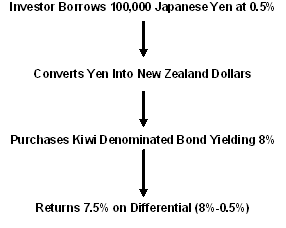
For example, taking one of the favored pairs in the market right now, let's take a look at the New Zealand dollar/Japanese yen currency pair. Here, a carry trader would borrow Japanese yen and then convert it into New Zealand dollars. After the conversion, the speculator would then buy a Kiwi bond for the corresponding amount, earning 8%. Therefore, the investor makes a 7.5% return on the interest alone after taking into account the 0.5% that is paid on the yen funds.


Now on the earning side of the trade, the investor is also hoping that the price will appreciate in order to make further gains on the transaction. In this case, anyone that has invested in the NZD/JPY trade has been able to reap plenty of benefits. For 2007, not only were traders able to benefit from a 7.5% return, they also benefit from a currency that has appreciated by 20.6% since the beginning of the year - a far cry from your ordinary U.S. Treasury bond. (For more on this strategy, see Currency Carry Trades Deliver.)

Flags and Pennants: Easy and Simple
With the currency rising the way it has, how can a trader really capture market profits in the bull market? One such formation that has proved to be a great setup may be the all too familiar: flag and/pennant formations. This has been especially useful in carry currency crosses such as British pound/Japanese yen and New Zealand dollar/Japanese yen. Both formations are used in similar capacities; they are great short-term tools that can be applied to capture nothing but continuations in the foreign exchange market. They are both even more applicable when the market, especially in the case of carry trade currencies, has been trading higher and higher in every session. (For more insight, read Analyzing Chart Patterns: Flags and Pennants.)

To get a better sense of how this works, let's quickly review the differences between a flag and a pennant:
  • A flag formation is a charting pattern that is indicative of consolidation following an upward surge in price. The name is attributed to the fact that it resembles an actual flag with a downward-sloping body (due to price consolidation) and a visually evident post. Targets are also very reliable in flag formations. Traders who use this technical pattern will reference the distance from the bottom of the post (significant support level) to the top. Subsequently, when the price breaks the upper trendline of the flag, the distance of the post will more often than not be equivalent to the next level of resistance.

  • A pennant formation is similar to the flag formation - it differs only in the form of consolidation. Instead of a body of consolidation that moves in the opposite direction of the post (as in the case of a flag), the pennant's body is simply a symmetrical triangle. Although pennants have been known to slope downward as well, the textbook formation has also been noted as a symmetrical triangle, hence the name.
Trade Setup
Let's take a look at a real-life example using the British pound/U.S. dollar in July 2007. Here, a 60-minute short-term chart offers a great opportunity in the GBP/USD in Figure 1. After convincingly breaking through resistance at the pivotal 2.0200 trendline, the underlying currency proceeds to top out at 2.0361 and consolidates. Forming a flag technical pattern, we note that the post is 160 pips in length and apply it when the currency breaks through the top trendline at 2.0330. As you can see, the estimate rings true as the pound sterling gains against the U.S. dollar far above market targets and tops out at 2.0544 before consolidating again.

Source: FX Trek Intellicharts
Figure 1: A perfect flag formation in the GBP/USD

Flag and Pennants in Carry Candidates
Similar setups are seen in the cross currency pairs, giving the trader plenty of opportunities in the currency market, with or without dollar exposure. (For more on these pairs see, Make the Currency Cross Your Boss.) Taking another market favorite, the British pound/Japanese yen, let's take a look at how this method can be applied to the chart.

In the short-term 60-minute chart in Figure 2, a typically long flag formation is coming around in the GBP/JPY currency pair. In order to establish the formation initially, it is recommended that the chartist draw the topside trendline first. This rule is a must as an initial drawing of the bottom trendline may lead to varying interpretations. Once the initial downward-sloping trendline is drawn, the bottom is a simple duplicate. Here, the trader will make sure to note a touch by the session bodies rather than the wicks in verifying the formation as true. This is to isolate only true price action and not volatility or common "noise" that may occur in the short term.

In Figure 2, the bottom trendline has been pushed slightly higher to incorporate the bodies rather than the wicks. Next, we measure the post. In this case, referencing a major support level at 245.69, we calculate the differential with the top of the move at 248.93. As a result, the distance between the two prices is 324 pips. Theoretically, this will place our ultimate target at 251.74 on a break of the trendline at 248.50.

Source: FX Trek Intellicharts
Figure 2: An extended flag formation offers plenty of opportunity.

Trading Rules
When placing the entry, always make sure of two things:
  1. The trade is on the side of carry. This means that the speculator is always buying the higher interest rate currency. In this case, the trade is going long pound sterling and gaining 5.25%.

  2. Always place the buy entry after the candle close. Applying a buy order after the break of the top trendline ensures that the trendline has been broken. Placing the entry before the close above the trendline may subject the order to being hit on possible market noise above the resistance barrier. This may leave the trader in an unfavorable position as consolidation continues.
Taking into account both rules, we place the entry on the close or slightly below, at 248.77. Risk takers will likely hold the carry trade until the full move has been completed. However, a more conservative strategy, and one that works more often than not, involves placing an initial target at the halfway mark. Taking into consideration the break at 248.50 and half of the full forecast of 324 pips, initial targets should be set at 250.12 with the corresponding stop five pips below the session low.

Step by Step
Now let's take a look at a step by step process that will allow traders to enter on the carry trade momentum in the market. Figure 3 shows a great opportunity in the New Zealand dollar/Japanese yen cross pair. Following the complete downturn that occurred July 9 - July11, 2007, a visual burst can be seen by chartists as bidders take the currency higher over the next 48 hours, establishing a temporary top at Point A.
Source: FX Trek Intellicharts
Figure 3: Following A Sharp Decline, NZDJPY Vaults Higher Off Of Support

Now we set the stage (Figure 4):

  1. After consolidation, draw the topside trendline first, completing the formation with the duplicate bottom trendline giving the chartist the flag boundaries.
  2. On a sign of a trendline break, measure the distance from the bottom of the post to the top. In this instance, the bottom support of the post is 93.81 with the top at 95.74. This gives the trader a potential for 193 pips on the trade after a break of the top trendline.
  3. Once there is a confirmed break of the trendline, place the entry that is at the session close or lower of the finished candle. In this case, the break occurs approximately at 95.40 with the entry being placed at that session's close of 95.46 (Point C). Subsequently, a corresponding stop is placed five pips below the session low of 95.37. Ultimately, the position is well within normal risk parameters as it is risking 14 pips to make 193 pips.
  4. Set initial and full targets. With the full move estimated at 193 pips, we get a partial distance of 96 pips (193 pips / 2). As a result, the initial target is set for 96.42 (Point B).
  5. Set contingent trailing stops. Once the initial target is achieved, the overall position should be reduced by half with the rest being protected by a trailing stop set at the entry price (or break-even). This will allow for further gains while protecting against adverse moves against whatever is left. Longer term strategies will hold to the entry price as the ultimate stop, promoting a worst-case scenario of break-even।
Incidentally, the initial target is achieved right before a slight retracement in the NZD/JPY currency in the example. Subsequently, the position remains on target for further gains as it continues to trade above the entry price.

Source: FX Trek Intellicharts
Figure 4: Trade setups in the NZD/JPY

Conclusion
Flags and pennants can accurately support profitable trading in the currency markets by assisting in the capture of overwhelming market momentum. In addition, applying strict money management rules and using a trained and disciplined eye, a trader can boost returns while helping the overall portfolio in capitalizing on the yield offered through the interest rate differential. Ultimately, sticking to those two tenets of market price and yield, FX investors can't go wrong being long on carry.

Currency Carry Trades Deliver

Whether you invest or trade in the stock, bond, commodities or currency market, it is likely that you have heard of the carry trade। This strategy has generated positive returns since the 1980s, but only in recent years has it received much media attention. For those of you who are still befuddled by what a carry trade is and why the hysteria surrounding the trade has extended beyond the currency market, welcome to Carry Trades 101. We will explore how a carry trade is structured, when it works, when it doesn't and the different ways that short- and long-term investors can apply the strategy.

What is the carry trade?
The carry trade is one of the most popular trading strategies in the currency market. Mechanically, putting on a carry trade involves nothing more than buying a high yielding currency and funding it with a low yielding currency, similar to the adage "buy low, sell high."

The most popular carry trades are currency pairs like the Australian dollar/Japanese yen, New Zealand dollar/Japanese yen and the British pound/Swiss franc because the interest rate spreads of these currencies pairs are very high. The first step in putting together a carry trade is to find out what currency offers a high yield and what one offers a low yield. (For related reading, see Using Currency Correlations To Your Advantage and Common Questions About Currency Trading.)

As of June 2007, the interest rates for the most liquid currencies in the world were as follows:

New Zealand (NZD) 8.00%
Australia (AUD) 6.25%
U.K. (GBP) 5.50%
U.S. (USD) 5.25%
Canada (CAD) 4.25%
Eurozone (EUR) 4.00%
Swiss franc (CHF) 2.25%
Japanese yen (JPY) 0.50%

With these interest rates in mind, it is simple to see which countries are offering the largest and smallest yields. Traders can keep on top of these interest rate levels by either visiting DailyFX.com or by going to the websites of specific central banks. Given the fact that New Zealand and Australia have the highest yields on our list while Japan has the lowest, it is hardly surprising that AUD/JPY is the poster child of carry trades. Currencies are traded in pairs so all an investor needs to do to put on the trade is to buy NZD/JPY or AUD/JPY on his or her forex trading platform.

The Japanese yen's low selling cost is an attribute that has been capitalized by equity and commodity traders as well. Over the past few years, investors in other markets have started putting on their own versions of the carry trade by shorting the yen and buying U.S. or Chinese stocks, for example. This has fueled a huge speculative bubble in both markets as well as strong correlation between carry trades and stocks.

The Mechanics of Earning Interest
One of the cornerstones of the carry trade strategy is the ability to earn interest. The income is accrued every day for long carry trades with triple rollover given on Wednesday to account for Saturday and Sunday rolls. Roughly speaking, the daily interest is calculated in the following way:

(Interest Rate of the Currency that you are Long – Interest Rate of the Currency that you are Short) x Notional of Your Position
# of Days in a Year


For 1 lot of NZD/JPY that has a notional of 100,000, we compute interest the following way:

(.8 – 0.005) x 100,000 = approximately $20 a day
365

It is important to realize that this amount can only be earned by traders who are long NZD/JPY. For those who are fading the carry, interest will need to be paid every day.

Why has a Strategy this Simple Become so Popular?
Between January 2000 and May 2007, the Australian dollar/Japanese yen currency pair (AUD/JPY) offered an average annual yield of 5.14%. For most people, this return is a pittance, but in a market where leverage is as high as 200:1, even the use of five to 10 times leverage can make that return extremely extravagant. Investors earn this return even if the currency pair fails to move one penny. However, with so many people addicted to carry trades, the currency almost never stays stationary. In the past 6.5 years, the AUD/JPY exchange rate increased 83%, bringing the cash-on-cash return on a long AUD/JPY trade to 100%. At two times leverage, that's 200%.


Source:FXTrek Intellicharts


If It Were Only This Easy
Unfortunately, the carry trade strategy is not just about going long a currency with a high yield and shorting a currency with a low yield. It is not difficult to realize that this strategy fails instantly if the exchange rate devalues by more than the average annual yield. With the use of leverage, losses can be even more significant, which is why when carry trades go wrong, the liquidation can be devastating. Therefore, it is important to understand when carry trades work and when they fail.

When do carry trades work?

Central Bank Increasing Interest Rates: Carry trades work when central banks are either increasing interest rates or plan on increasing them. Money can now be moved from one country to another at the click of a mouse, and big investors are not hesitant to move money from one country to another in search of not only high, but also increasing, yield. The attractiveness of the carry trade is not only in the yield, but also the capital appreciation. When a central bank is raising interest rates, the world notices and there are typically many people piling into the same carry trade, pushing the value of the currency pair higher in the process. The key is to try to get into the beginning of the rate tightening cycle and not the end. (To learn more, read Trying To Predict Interest Rates and Get To Know The Major Central Banks.)

Low Volatility, Risk-Seeking Environment: Carry trades also perform well in low volatility environments because traders are more willing to take on risk. What carry traders are looking for is the yield - any capital appreciation is just a bonus. Therefore, most carry traders, especially the big hedge funds who have a lot of money at stake, are perfectly happy if the currency does not move one penny, because they will still earn the leveraged yield. As long as the currency doesn't fall, carry traders will essentially get paid while they wait. Also, traders and investors are more comfortable with taking on risk in low volatility environments. When they take on risk, it has become a habit to fund these riskier trades with short yen positions.

When do carry trades fail?

Central Bank Reduces Interest Rates: The profitability of carry trades comes into question when the countries who offer high interest rates begin to cut them. The initial shift in monetary policy tends to represent a major shift in trend for the currency. For carry trades to succeed, the currency pair either needs to not change in value or appreciate. When interest rates decrease, foreign investors are less compelled to go long the currency pair and are more likely to look elsewhere for more profitable opportunities. When this happens, demand for the currency pair wanes and it begins to sell off. Depreciation in the currency pair could easily wipe out any interest income.

Central Bank Intervenes in Currency: Carry trades will also fail if a central bank intervenes in the foreign exchange market to either stop its currency from rising or prevent it from falling further. For countries that are export dependent, an excessively strong currency could take a big bite out of exports while an excessively weak currency could lead to significant backlash. This is particularly true for the Japanese yen, the preferred funding currency, because many companies in foreign nations have complained loudly that the weakness in the Yen is making their goods less competitive in the global market. They have asked their own politicians to put pressure on the Japanese to either increase interest rates or intervene in the currency to prevent it from falling even more. Either of these tactics would strengthen the yen, which would bring down the exchange rate of carry trades. The same can be said of intervention by the Reserve Bank of New Zealand to weaken the value of the New Zealand dollar.

Best Way to Trade Carry is Through a Basket
With the pros and cons of carry trading in mind, the best way to trade carry is through a basket. When it comes to carry trades, at any point in time, one central bank may be holding interest rates steady while another may be increasing or decreasing them. With a basket that consists of the three highest and the three lowest yielding currencies, any one currency pair only represents a portion of the whole portfolio; therefore, even if there is carry trade liquidation in one currency pair, the losses are controlled by owning a basket. This is actually the preferred way of trading carry for investment banks and hedge funds. This strategy may be a bit tricky for individuals because trading a basket would naturally require greater capital, but it can be done with smaller lot sizes. The key with a basket is to dynamically change the portfolio allocations based upon the interest rate curve and monetary policies of the central banks.

Benefiting from the Carry Trade
The carry trade is a long-term strategy that is far more suitable for investors than traders because investors will revel in the fact that they will only need to check price quotes a few times a week rather than a few times a day. True carry traders, including the leading banks on Wall Street, will hold their positions for months (if not years) at a time. The cornerstone of the carry trade strategy is to get paid while you wait, so waiting is actually a good thing.

Partly due to the demand for carry trades, trends in the currency market are strong and directional. This is important for short-term traders as well because, in a currency pair where the interest rate differential is very significant, it may be far more profitable to look for opportunities to buy on dips in the direction of the carry than to try to fade it. For those who insist on fading AUD/JPY strength for example, they should be wary of holding short positions for too long because with each passing day, more interest will need to be paid. The best way for shorter term traders to look at interest is that earning it helps to reduce your average price while paying interest increases it. For an intraday trade, the carry will not matter, but for a three-, four- or five-day trade, the direction of carry becomes far more meaningful.

by Kathy Lien, Chief Strategist, FXCM